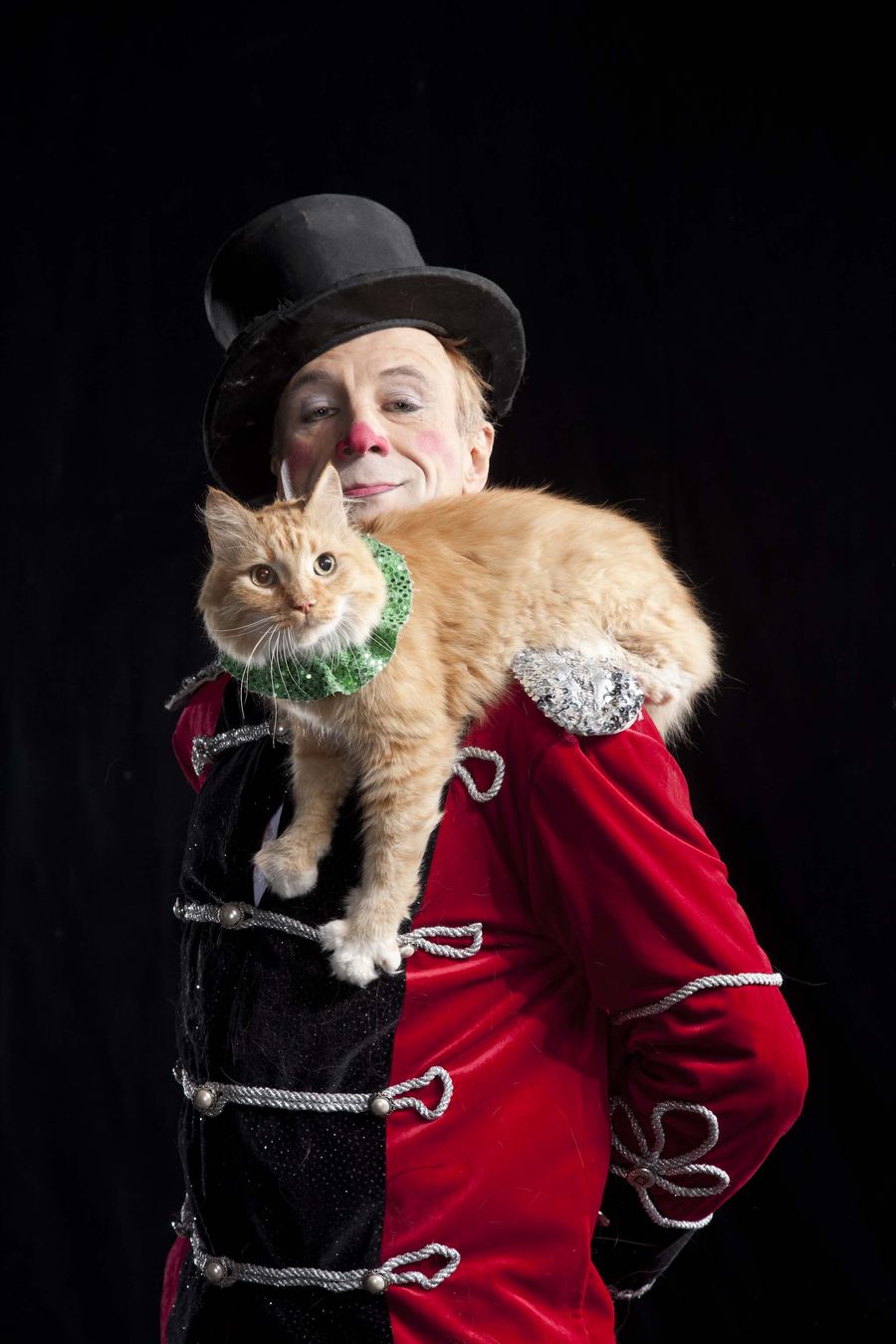
Every cat in our Las Vegas cast was adopted from a shelter — and every one of them disproves the oldest myth in pet ownership, matinee after matinee.
People tell me, with complete confidence, that cats cannot be taught anything. They often say it while a shelter cat named Snowbird sits calmly beside me under the stage lights in Las Vegas. Every cat in our cast was taken from a shelter, and every one of them proves the skeptics wrong at every performance.
This entry is about the psychology behind that proof, and about what it means for the cat asleep on your sofa right now.
Why the Myth Refuses to Die
The myth survives because it is built on a half-truth. Cats really do not respond the way dogs do. A dog will often work for approval alone; a cat first asks a perfectly fair question: what does this have to do with me? Many owners mistake that question for indifference, stop trying — and the myth quietly confirms itself.
The second reason is pressure. Most failed attempts at teaching a cat rely on insisting: repeating, pushing, raising the voice. A cat under pressure does not argue — it simply leaves the room. That is not stubbornness. It is self-respect, and it deserves ours. A cat’s cooperation cannot be demanded; it can only be invited.
Watch our cast members closely and you will notice something simple: on stage they do what cats already love doing — climbing, leaping, balancing, exploring. That is the place to start at home too: with what your cat already enjoys.
How Praise and Intonation Work
Cats read tone long before they learn words. Your voice carries a melody, and that melody is the clearest signal your cat receives from you. A warm, bright intonation at the right moment tells a cat precisely which choice just earned your delight. That is what praise really is — not a ceremony, but information.
Timing decides everything. Praise that arrives the instant a behavior happens gets connected to that behavior; praise that arrives a minute later is just pleasant noise. Choose one warm phrase, keep the same melody every time, and deliver it in the exact second your cat does the thing you hoped for.
Food has its place at the beginning, but a treat alone is a transaction. In our work the voice gradually becomes the true signal, and the treat becomes a bonus. That shift is the difference between a bribe and a bond — and a bond is the only thing a cat will keep working for over a lifetime.
Cause and Effect, Not Pressure
At the heart of it is cause-and-effect learning. A cat repeats what reliably pays off and abandons what does not. Your job is to guide, not to correct: arrange the world so that the choice you want is the easy, rewarding one — and the choice you don’t want simply pays nothing.
This is where punishment fails completely. Punishment does not teach a cat that scratching the sofa is wrong; it teaches the cat that you are unpredictable and occasionally frightening. The scratching continues — just not in front of you — and the trust you need for everything else quietly erodes. A scratching post placed where the cat already loves to stretch, praised the first time it is used, does what a hundred scoldings never will.
The same logic runs through every familiar frustration — the litter box refusal, the early-morning yowling, the sudden swats. Behind each one is a cause your cat understands perfectly, and an effect you have far more influence over than you think.
From the book
A guide for cat owners: considerate behavior, health and fitness, playful tricks.
$15.00
Where to Start at Home
You do not need a stage, equipment, or experience. You need three principles, applied with patience.
★ Start with what your cat already does. Notice the natural behaviors your cat offers freely — the hop onto the bench, the paw raised in curiosity — and praise them warmly the instant they happen. You are not inventing behavior; you are naming it.
★ Keep it short and end on a success. A few unhurried minutes are worth more than a determined hour. Stop while your cat is still interested, and the next session will begin with enthusiasm instead of suspicion.
★ Let your cat say no. Mutual respect is not a slogan; it is the method. A cat that is free to walk away, and is never punished for it, is a cat that chooses to come back — and choice is where real learning lives.
That is the whole psychology. No dominance, no drills, no pressure — just praise, timing, and cause and effect, offered by a person the cat has decided to trust. Snowbird learned this way after the shelter. So did Diamond, our mini horse, and Lucy, our mini pig — and your cat is every bit as capable.
If a shelter cat can learn to be calm under the lights of a Las Vegas matinee, your cat can learn the gentle manners of your own home. Start tonight, start small, and say the kind word at the right second. Your cat has been waiting for you to notice.
From the book
You Can Train Your Cat
A guide for cat owners: considerate behavior, health and fitness, playful tricks.
$15.00
About the author
Gregory Popovich — Vaudeville Performer & Humane Animal Training Expert
Gregory Popovich is a fourth-generation circus performer who grew up backstage while his parents performed in the Moscow Circus, and developed a deep understanding of animals. He trains every animal performer himself. His cast of more than 25 animals, all taken from shelters, performs with him in Las Vegas.